![wicked logo.webp]](https://help.wickedreports.com/hs-fs/hubfs/wicked%20logo.webp?height=40&name=wicked%20logo.webp)
On This Page
- How attribution models work
- How Wicked determines eligible clicks
- U-Shaped — Recommended
- First Click
- Last Click
- Linear
- Which model should I use?
- FAQ
How attribution models work
When a customer interacts with more than one marketing source before purchasing, there is an important question to answer:
Which marketing interaction should receive credit for the sale?
Wicked 2.0 gives you four attribution models:
- First Click
- Last Click
- U-Shaped (40/20/40)
- Linear
Each model looks at the same customer journey but distributes attribution credit differently.
All four models use Wicked 2.0's Click Date attribution approach.
How does Wicked determine eligible clicks?
For each order, Wicked evaluates the clicks in the 90 days prior to the sale.
Before assigning credit, Wicked deduplicates subsequent identical clicks.
For example, if a customer's journey contains:
Meta → Meta → Google
the two subsequent Meta interactions can be treated as one eligible interaction.
Deduplication happens at the level you are analyzing, such as:
- Channel
- Campaign
- Ad Set
- Ad
Once the eligible interactions are identified, your selected attribution model determines how credit is distributed.
U-Shaped (40/20/40) — Recommended
Wicked recommends U-Shaped attribution for most customers.
U-Shaped gives the most weight to two important points in the customer journey:
- 40% to the first eligible click
- 40% to the last eligible click
- The remaining 20% divided evenly among the eligible clicks in between
Example
Customer journey:
Meta → YouTube → Google → Purchase
Attribution:
- Meta: 40%
- YouTube: 20%
- Google: 40%
Why does Wicked recommend U-Shaped?
The first click helps explain what initially brought the customer into the journey.
The last click helps explain what marketing interaction occurred closest to the purchase.
U-Shaped gives those two interactions the most weight while still recognizing the marketing touches that influenced the customer in between.
For many customer journeys, this provides a balanced representation of how marketing contributed to the sale.
.png?width=670&height=728&name=U-Shaped%20(402040).png)
What if there are only one or two clicks?
If there is only one eligible click, it receives 100% of the credit.
If there are two eligible clicks, each receives 50%.
If there are three or more eligible clicks, the first and last each receive 40%, and the eligible middle clicks split the remaining 20% evenly.
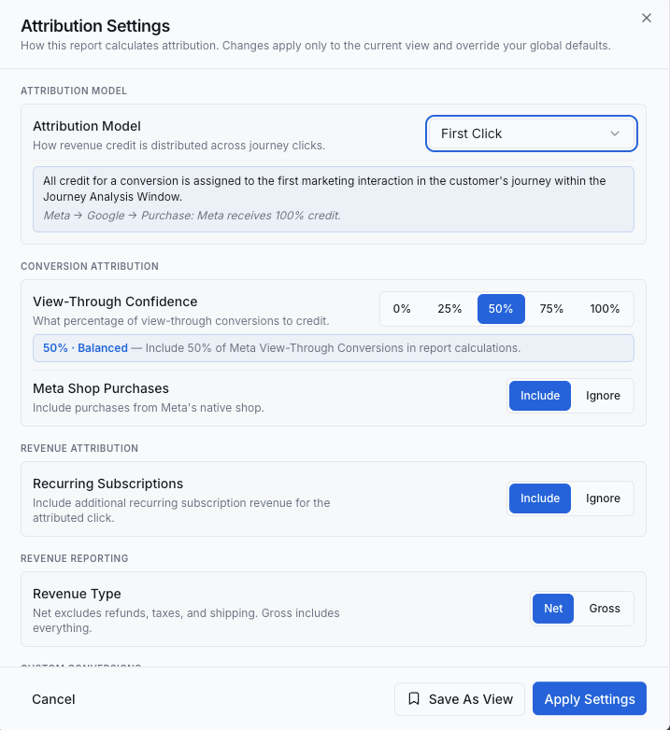
First Click
First Click assigns 100% of the credit to the first eligible click in the customer's 90-day journey.
Example
Customer journey:
Meta → YouTube → Google → Purchase
Attribution:
- Meta: 100%
- YouTube: 0%
- Google: 0%
When should I use First Click?
Use First Click when your primary question is:
“What originally brought this customer into the journey?”
It is useful when you want to emphasize discovery or customer acquisition.
The tradeoff is that marketing interactions occurring later in the journey receive no attribution credit.
Last Click
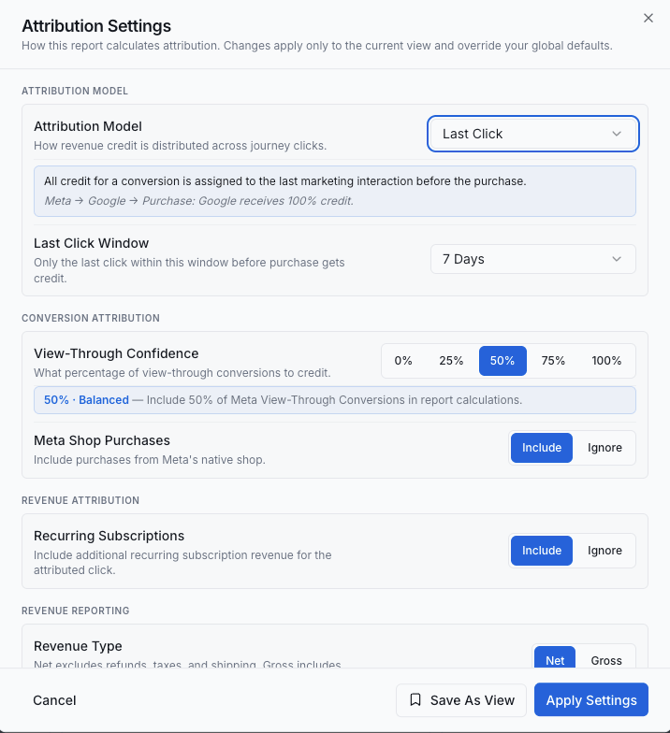
Last Click assigns 100% of the credit to the final eligible marketing interaction before the purchase.
Example
Customer journey:
Meta → YouTube → Google → Purchase
Attribution:
- Meta: 0%
- YouTube: 0%
- Google: 100%
When should I use Last Click?
Use Last Click when your primary question is:
“What was the final marketing interaction before this customer purchased?”
It emphasizes the interaction closest to the conversion.
The tradeoff is that earlier marketing that introduced or influenced the customer receives no attribution credit.
Linear
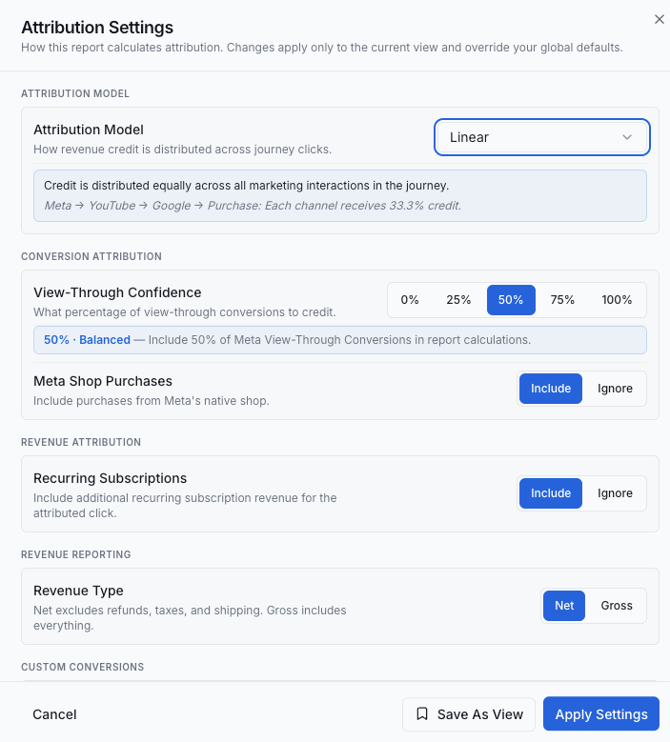
Linear attribution distributes credit equally across all eligible clicks after subsequent identical interactions are deduplicated.
Example
Customer journey:
Meta → YouTube → Google → Purchase
There are three eligible interactions.
Attribution:
- Meta: 33.3%
- YouTube: 33.3%
- Google: 33.3%
When should I use Linear?
Use Linear when you want every eligible marketing interaction in the customer journey to receive equal weight.
Linear does not assume that the first or last interaction was more valuable than the touches that happened in between.
Which attribution model should I use?
For most customers, Wicked recommends starting with U-Shaped (40/20/40).
The best model depends on the question you are trying to answer.
Use U-Shaped when:
You want a balanced view that emphasizes both the beginning and end of the customer journey while still giving credit to the marketing interactions in between.
Use First Click when:
You primarily want to understand what originally brought the customer into the journey.
Use Last Click when:
You primarily want to understand the final marketing interaction before purchase.
Use Linear when:
You want every eligible interaction to receive equal attribution credit.
The most important thing is consistency.
Changing attribution models changes how credit is distributed, which can change metrics such as attributed revenue and ROAS.
Once you choose the model that best answers your reporting question, evaluate performance consistently using that model.
FAQ
Which attribution model does Wicked recommend?
U-Shaped (40/20/40) is the recommended attribution model in Wicked 2.0.
Does U-Shaped always assign 40/20/40?
When there are at least three eligible interactions:
- First click: 40%
- Last click: 40%
- Eligible middle clicks: evenly divide the remaining 20%
With one eligible click, that click receives 100%.
With two eligible clicks, each receives 50%.
How far back does Wicked look for clicks?
Wicked evaluates clicks during the 90 days prior to the order.
What happens if a customer clicks the same source multiple times in a row?
Subsequent identical clicks are deduplicated before attribution credit is assigned.
What counts as identical depends on the reporting level being analyzed, such as Channel, Campaign, Ad Set, or Ad.
Does changing the attribution model change the sale?
No.
The sale remains the same. The attribution model changes how marketing credit for that sale is distributed across eligible interactions.
Why can my ROAS change when I change attribution models?
ROAS uses attributed revenue.
When you change the attribution model, the same sale may assign revenue credit to different marketing interactions. That can change the ROAS reported for individual channels, campaigns, ad sets, or ads.
Is one attribution model objectively correct?
No single model answers every marketing question.
Each model represents a different way of assigning credit across the customer journey. Wicked recommends U-Shaped as a practical default because it emphasizes the first and last interactions while still recognizing the marketing activity in between.