![wicked logo.webp]](https://help.wickedreports.com/hs-fs/hubfs/wicked%20logo.webp?height=40&name=wicked%20logo.webp)
What Is Halo Modeling?
Wicked Reports attribution connects marketing clicks to the customers, sales, and revenue they generate. But not every marketing channel influences customers by generating a click.
Some channels are particularly effective at creating awareness and demand. A customer may see a video, discover your brand, remember it, and eventually purchase through another path without ever clicking the marketing that originally influenced them.
That creates a challenge for click-based attribution:
How do you account for marketing that influenced a purchase when there isn't a click connecting that marketing to the customer?
Halo Modeling provides an additional layer of analysis designed to help account for that influence.
It redistributes a portion of existing attributed revenue and customers from channels likely to be receiving more credit toward paid channels that may be creating demand without receiving enough click-based attribution.
Halo Modeling does not create additional revenue or customers. It changes how existing attribution credit is distributed among your marketing channels.
Why Halo Modeling Exists
Modern customer journeys don't always happen through a series of trackable clicks.
Consider a customer who:
- Watches a YouTube ad.
- Doesn't click it.
- Remembers the brand.
- Searches for the company several days later.
- Clicks a Google ad.
- Purchases.
Wicked Reports can track the Google click and connect it to the purchase.
But what about the YouTube ad?
From a click-attribution perspective, there may be no evidence connecting that YouTube ad to this specific customer. The customer never clicked it.
Yet the YouTube ad may have been the reason the customer searched for the brand in the first place.
That's the halo effect Halo Modeling is designed to help account for.
Demand Creation vs. Demand Capture
One useful way to think about Halo Modeling is the difference between creating demand and capturing demand.
Demand Creation vs. Demand Capture
One useful way to think about Halo Modeling is the difference between creating demand and capturing demand.
Demand-Creating Marketing
Some marketing introduces people to your brand, builds awareness, or creates interest before they're ready to purchase.
This is especially common with visual and video-driven advertising such as:
- YouTube
- TikTok
- Meta video advertising
Customers may see this marketing without clicking it.
If they eventually purchase through another route, the demand-generating channel can receive less attribution credit than the influence it actually had.
Demand-Capturing Marketing
Other marketing is more likely to interact with customers after demand already exists.
A customer might:
See an ad → remember the company → search for the brand → click → purchase
The later click is valuable, but it may also be capturing demand that another marketing investment helped create.
Halo Modeling gives you a way to account for this relationship.
The Limitation of Click-Based Attribution
Wicked Reports provides sophisticated attribution across the clicks it can observe.
Halo Modeling addresses a different problem:
Click attribution can only directly assign credit to marketing interactions Wicked can track.
That distinction becomes increasingly important with awareness-focused advertising.
Imagine you spend heavily on TikTok and discover that:
- TikTok receives relatively little attributed revenue.
- Customers frequently see your videos but don't click.
- Customers later arrive through other channels and purchase.
- When TikTok spend decreases, total business performance declines more than TikTok's attributed revenue would have suggested.
Click attribution alone may make TikTok look less valuable than it really is.
Halo Modeling gives you another lens through which to evaluate that investment.
What About Unattributed Revenue?
The same issue can occur when Wicked Reports receives a sale but has no marketing click it can connect to the purchase.
Wicked Reports classifies that revenue as Unattributed.
That doesn't necessarily mean marketing had no influence on the sale.
For example, a customer could:
See a Meta ad → search for the product on Amazon → purchase on Amazon
If the Amazon order eventually reaches Wicked Reports but the customer's journey on Amazon can't be connected to the Meta exposure, the order may appear as Unattributed.
Offline purchases can create similar situations.
Halo Modeling allows Unattributed revenue and customers to participate in the redistribution of credit toward paid channels that may have helped create that demand.
This is why Unattributed always contributes to the Halo redistribution pool when Halo Modeling is used.
How Halo Modeling Works
At a high level, Halo Modeling places channels into one of three roles:
Gives
A Gives channel contributes some of its existing attributed credit to a redistribution pool.
These are generally channels where you believe some of the conversions being credited to the channel may have been influenced by marketing elsewhere.
Gets
A Gets channel can receive attribution credit from the redistribution pool.
These are typically paid channels where you believe click-based attribution may understate their influence—particularly channels that rely heavily on views and awareness rather than clicks.
Neutral
A Neutral channel keeps its existing attribution unchanged.
It neither contributes credit to nor receives credit from the redistribution pool.
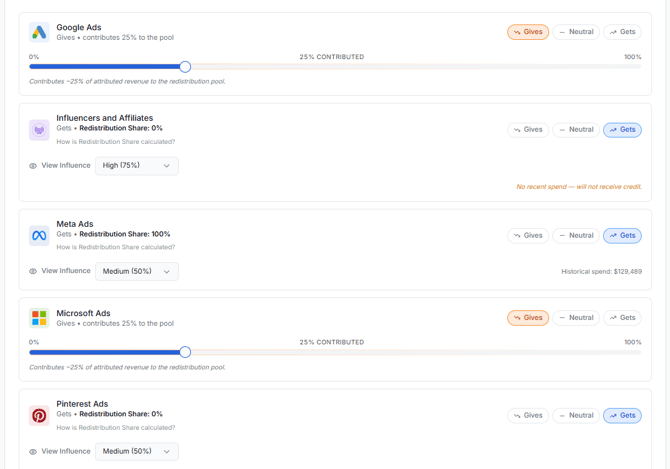
Halo then redistributes the available credit among eligible Gets channels according to your Halo Modeling configuration.
We'll cover how to configure those roles and determine redistribution in Halo Modeling Settings.
Why Ad Spend Matters
Halo isn't designed to simply give additional attribution credit to every awareness channel.
The channel needs to be an active marketing investment.
For example, suppose TikTok is configured as a Gets channel because you believe TikTok creates substantial awareness.
If you're currently spending nothing on TikTok, it wouldn't make sense to assume TikTok advertising is responsible for creating current demand.
That's why recent ad spend is one of the signals Halo Modeling uses when determining which Gets channels should receive redistributed credit.
As investment increases, the channel has greater opportunity to create demand. As investment disappears, so does its eligibility to receive Halo credit.
Why View Influence Matters
Spend alone doesn't tell the whole story.
Different advertising channels rely on clicks and views differently.
Consider two paid channels with the same ad spend.
One might generate substantial click activity that Wicked Reports can already track.
The other might primarily expose customers to video content that influences them without generating many clicks.
The second channel has a larger potential blind spot in a click-based attribution system.
Halo Modeling therefore lets you account for a channel's View Influence—how strongly you believe the channel relies on views and awareness to influence customers rather than trackable clicks.
For example, you might believe TikTok has greater View Influence than Meta because your TikTok strategy relies more heavily on video consumption without clicks.
Halo combines this awareness influence with recent ad spend when determining how redistributed credit should be allocated among Gets channels.
An Example
Suppose your existing attribution shows:
| Channel | Attributed Revenue |
|---|---|
| Meta Ads | $20,000 |
| YouTube | $5,000 |
| Google Ads | $40,000 |
| Organic | $25,000 |
| Unattributed | $10,000 |
| Total | $100,000 |
Based only on tracked clicks, Google and Organic appear to be responsible for significantly more revenue than Meta and YouTube.
But you know your business spends heavily on Meta and YouTube for awareness. Those channels generate substantial video exposure, and customers frequently find the business later through search, organic traffic, or other paths.
You configure Halo Modeling to account for that potential influence.
Halo can redistribute some attribution credit toward eligible awareness channels.
Your Halo results might then look conceptually like:
| Channel | Standard Attribution | Halo Modeled |
|---|---|---|
| Meta Ads | $20,000 | ↑ |
| YouTube | $5,000 | ↑ |
| Google Ads | $40,000 | — |
| Organic | $25,000 | ↓ |
| Unattributed | $10,000 | ↓ |
| Total | $100,000 | $100,000 |
The exact redistribution depends on your Halo Modeling settings.
The important point is what doesn't happen:
Halo doesn't turn $100,000 of revenue into $120,000.
The business still generated $100,000.
Halo provides a different way of distributing attribution credit for that $100,000 based on your assumptions about cross-channel influence.
Halo Modeling Is a Layer on Top of Attribution
Halo Modeling is not another attribution model.
You don't choose between U-Shaped attribution or Halo Modeling.
Your existing attribution model first determines how Wicked Reports assigns credit across the trackable customer journey.
Halo Modeling is then applied as an additional redistribution layer on top of those attribution results.
Think of it as:
Tracked Customer Journey → Attribution → Halo Modeling
This allows you to retain Wicked Reports' click-based attribution while also evaluating how performance changes when you account for potential influence that isn't visible through clicks alone.
Halo Uses Actual Performance
Halo Modeling redistributes Actual attributed results.
It does not redistribute Predicted Future performance.
This means Halo results are based on conversions and revenue that have already occurred rather than the additional conversions Wicked Reports predicts may occur as recent marketing matures.
When Should You Consider Using Halo Modeling?
Halo Modeling is particularly useful when your marketing strategy includes significant investment in channels that can influence customers without generating trackable clicks.
You may want to explore Halo Modeling when:
- You invest heavily in video or awareness advertising.
- You use channels such as YouTube, TikTok, Meta video, or Pinterest.
- A channel appears weaker in click attribution than you would expect based on its role in your marketing.
- Reducing spend on a top-of-funnel channel appears to hurt overall business performance more than its attributed revenue would suggest.
- Customers frequently discover you through advertising but later purchase through search, organic traffic, Amazon, offline channels, or another route.
- You have meaningful Unattributed revenue that may be influenced by paid awareness activity.
- You want to evaluate demand creation separately from what click attribution alone can observe.
Halo Modeling is most valuable when you have a business reason to believe the marketing creating demand and the marketing receiving attribution credit aren't always the same thing.
What Halo Modeling Does Not Do
It's just as important to understand what Halo does not represent.
Halo does not create additional revenue.
It redistributes attribution credit for revenue and customers that already exist.
Halo does not replace your attribution model.
It operates as a layer on top of your existing attribution results.
Halo does not prove that a specific ad view caused a specific purchase.
When Wicked Reports has a tracked click, attribution can connect that marketing interaction to the customer's journey.
The influence Halo is accounting for may not have that same direct customer-level connection.
Halo therefore models that potential influence using your configuration rather than claiming to have observed an interaction that wasn't tracked.
Halo is not an incrementality test.
Halo can help you think differently about marketing influence, but it isn't a controlled incrementality experiment or holdout test.
Halo doesn't change your actual business performance.
Your total sales, customers, and revenue remain the same.
Halo changes where attribution credit is assigned, not what happened in your business.
Where You'll See Halo Results
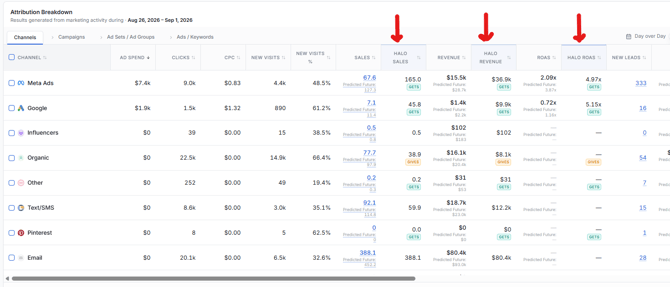
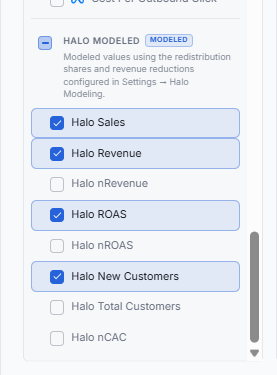
Once Halo Modeling is configured, Halo metrics can be added to the Attribution Report.
These include metrics such as:
- Halo Sales
- Halo Revenue
- Halo nRevenue
- Halo ROAS
- Halo nROAS
- Halo New Customers
- Halo Total Customers
- Halo nCAC
This lets you compare standard attributed performance with Halo-modeled performance.
For example, comparing Revenue with Halo Revenue can show how a channel's attributed revenue changes after Halo redistribution.
Comparing nCAC with Halo nCAC can show how your view of customer acquisition efficiency changes when Halo-modeled new customers are considered.
For detailed instructions, see Using Halo Modeling in the Attribution Report.
Getting Started
Halo Modeling is configured under:
Settings → Halo Modeling
Wicked Reports provides a starting configuration designed around common channel behaviors, which you can then adjust for your own marketing strategy.
Your configuration determines:
- Which channels Give
- Which channels Get
- Which channels remain Neutral
- How much credit Gives channels contribute
- How strongly Gets channels rely on view-based influence
- How spend and awareness influence are weighted when redistributing credit
For step-by-step instructions, see Configuring Halo Modeling.
Frequently Asked Questions
Does Halo Modeling change my total revenue?
No.
Halo Modeling redistributes attribution credit among channels. It does not add revenue to or remove revenue from your business.
If your business generated $100,000, Halo Modeling doesn't turn that into $110,000. It changes how some of the $100,000 is credited across your marketing channels.
Is Halo Modeling an attribution model?
No.
Halo Modeling is a redistribution layer applied after your existing attribution results are calculated.
You can continue using your preferred attribution model while also evaluating Halo-modeled performance.
Is Halo Modeling the same as incrementality?
No.
Halo Modeling can help account for marketing influence that click-based attribution may not fully observe, but it is not an incrementality experiment.
It doesn't use a control or holdout group to prove the incremental revenue caused by a marketing channel.
Instead, it models how attribution credit could change based on your assumptions about channel influence and current marketing investment.
Why would a video channel need Halo Modeling?
Video and awareness-focused marketing can influence customers without generating clicks.
Someone can watch a YouTube, TikTok, or Meta video ad, remember your company, and purchase later through another channel.
If the customer never clicks the video ad, click attribution can't directly connect that exposure to the eventual purchase.
Halo Modeling gives you a way to account for that potential influence.
Why can Unattributed revenue contribute to Halo?
Unattributed means Wicked Reports doesn't have a qualifying tracked marketing interaction to which it can assign the conversion.
It doesn't necessarily mean marketing had no influence.
For example, someone could discover your product through paid advertising and later purchase on Amazon or through an offline path where Wicked Reports can't connect the purchase back to that marketing exposure.
Halo Modeling allows some of that Unattributed credit to be redistributed toward eligible paid channels that may have helped create the demand.
Does a Gets channel automatically receive more credit?
No.
Being configured as Gets makes the channel eligible to receive redistributed credit, but the amount it receives depends on the Halo configuration and its recent ad spend.
A Gets channel with no recent spend will not receive Halo credit.
Should every top-of-funnel channel be configured as Gets?
Not necessarily.
Gets should represent paid channels where you believe click attribution may be understating the channel's influence.
How much a channel relies on views versus clicks also varies by business and marketing strategy.
Wicked Reports provides starting assumptions, but Halo Modeling can be adjusted to better reflect how your company actually markets.
Why doesn't Halo just use ad spend to redistribute credit?
Spend tells you how much you're investing in a channel, but it doesn't tell you how likely that channel is to influence customers without generating clicks.
Halo Modeling considers both recent ad spend and View Influence.
This helps distinguish between a channel where most influence is already visible through clicks and one where substantial influence may occur through views and awareness.
Does Halo Modeling use Predicted Future results?
No.
Halo Modeling uses Actual attributed results.
Predicted Future performance is not included in Halo redistribution.
How do I know if Halo Modeling is right for my business?
Start by considering how customers discover and purchase from your business.
If most of your marketing produces directly trackable clicks and customers generally purchase through those same journeys, Halo may have less impact.
If you invest heavily in awareness, video, or top-of-funnel advertising and believe those investments create demand that later converts through other channels, Halo Modeling can provide an important additional perspective on performance.